Arrange commercial roof leak repair in Centennial. We trace water entry, examine affected materials and separate immediate protection from permanent work.
Closing an office room for another rain event makes the leak investigation a scheduling decision as well as a repair expense. We begin with the occupied space that needs protection and the roof areas that can be accessed safely. Commercial Roofing Centennial traces active commercial leaks in Centennial, CO, before defining permanent correction. The immediate goal is to limit intrusion while establishing which part of the building requires work.
Greenwood Village includes business areas such as Greenwood Plaza and the Denver Tech Center, alongside regional office activity. For a building serving that office market, a leak can affect desks, communications equipment or a shared tenant corridor. We discuss the affected operation and then investigate the water route through the roof and adjoining construction. That sequence helps the owner distinguish temporary protection, roof repair and any related interior recovery that needs separate coordination.
Water near electrical equipment, wet ceiling materials or a slick occupied walkway requires prompt attention inside the building. Keep people away from unstable or energized areas and involve the appropriate building personnel. We discuss safe roof access while the interior team protects equipment and limits exposure. Entering an unsafe room or climbing onto a wet roof can create additional harm before a repair is underway.
A clear account of the intrusion helps guide examination without substituting for physical investigation. We record which room is affected, where water becomes visible and whether it appears during rainfall, snowmelt or equipment operation. Photographs can preserve conditions that change before the roof is accessible. An active leak also needs a response proportionate to ongoing exposure. Where water cannot be controlled through a limited repair, emergency temporary protection may be necessary before detailed investigation continues.
Water can travel along insulation interfaces, deck profiles or building components before becoming visible indoors. We compare the interior location with nearby roof seams, curbs, drains and wall transitions. The examination considers how those components connect rather than treating the nearest roof spot as the automatic repair boundary. A leak at a perimeter room may involve wall flashing or adjoining construction as well as the membrane.
Controlled testing can help isolate an entry route when the building and conditions permit a suitable method. It must avoid unnecessary interior exposure and allow enough separation between tested areas to interpret the result. We also inspect apparent repairs for compatibility and adhesion. A previous patch may cover one opening while a nearby transition remains defective. The investigation identifies the connection needing work so the repair expense addresses water entry rather than only the indoor symptom.
An open membrane seam requires suitable preparation and a compatible connection across sound material. A loose wall termination may require removal of failed sealing and correction of the securement above the flashing. At a drain, damaged clamping components or a deteriorated membrane connection can admit water directly into the assembly. We determine which component has failed before choosing the repair material and extent.
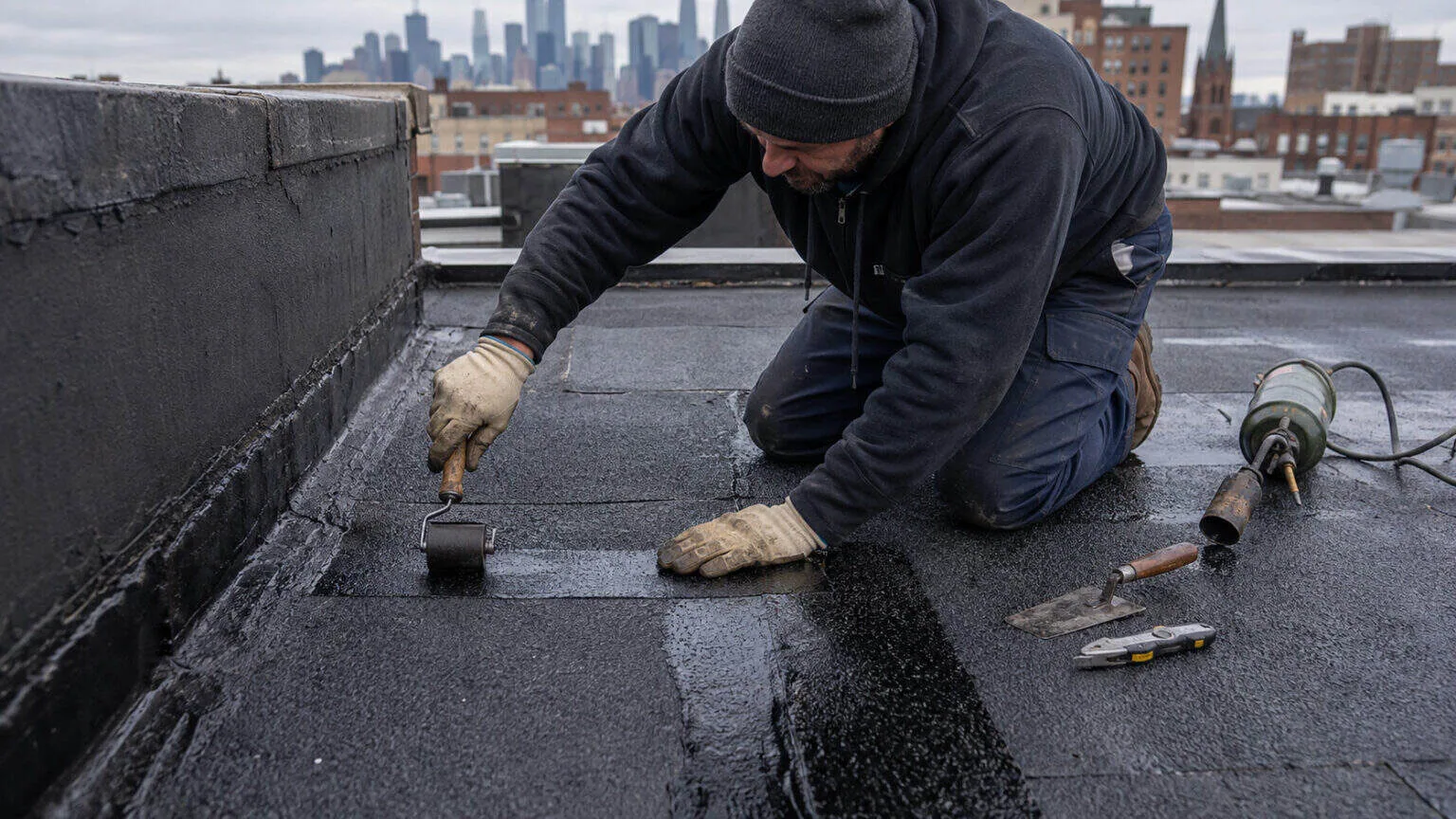
Flashing correction may involve rebuilding corners, replacing deteriorated material or adjusting a low detail. Where equipment crowds the working area, access may require coordination with the mechanical trade. For modified bitumen assemblies, the existing layers and repair method require particular attention to compatible materials and surrounding protection. We explain these practical differences because the size of an indoor stain does not establish the amount of roof construction needed.
Repairing an opening does not remove water already held inside the roof assembly. We assess affected insulation and supporting material where continued moisture could impair the repair or conceal deterioration. Selected openings may establish whether a limited membrane correction is sufficient or whether wet material also needs replacement. The owner should understand that distinction before treating a stopped drip as completion of all necessary work.
We may recommend an appropriate moisture investigation when the affected extent is uncertain and the assembly is suitable for that method. Thermal observations guide further examination rather than establish moisture quantities by themselves. Conditions at penetrations and drains can require physical checks even where wider scanning is useful. Defined removal limits help prevent repair work from leaving saturated material beneath a renewed covering. Those limits also make the repair allowance more useful for evaluating the complete correction.
Lincoln Station District in Lone Tree combines office and retail development with housing and transit access. That setting illustrates the varied occupied uses that may share building entrances, delivery areas or service routes. For leak work, the actual affected space determines where protection and access need coordination. Roof investigation may need a different window from interior cleanup or equipment recovery, particularly where tenant operations continue nearby.
Our assessment of Lincoln Station commercial properties includes the route to the suspected entry area and the access needed for permanent work. We distinguish conditions that can be corrected during the initial visit from work needing dry surfaces or a released equipment detail. Suitable installation conditions remain necessary after the active intrusion slows. An unresolved transition deserves a definite follow-up scope rather than reliance on temporary protection through repeated weather events.
The permanent scope identifies the failed component, repair boundary and any wet construction removed during correction. We examine the completed connections and explain where additional observation or testing is appropriate. Interior finishes may need time to dry before their condition can be assessed, while electrical and mechanical concerns require the relevant trade. These activities should be coordinated without treating roof repair as a substitute for interior safety review.
A roof condition record can distinguish the repaired area from adjoining conditions that deserve later maintenance. Photographs support future comparison if water reappears or another defect develops. We also identify recurring causes such as service traffic, obstructed drainage or a deteriorated wall connection. The owner can then arrange the necessary follow-through instead of budgeting repeatedly for an undefined leak location.
Condensation or equipment discharge can create indoor water without a membrane opening. We compare the timing and route with roof and mechanical conditions. Where equipment is involved, the investigation may need mechanical assistance so the correction reaches the actual cause.
Safe interior protection comes first, including appropriate handling of unstable or wet materials. Final finish restoration generally benefits from resolving water entry and assessing drying conditions. Building personnel and the relevant trades should coordinate those decisions alongside the roof work.
Water retained beneath the opening can damage support and prevent suitable repair conditions. We examine that material where evidence warrants opening the assembly. Confirmed wet construction may need replacement even after the visible membrane defect is corrected.
Access to the upper connection becomes the deciding issue. The correction may involve securement or wall-related work above the roof flashing, not only the field membrane. We identify the necessary boundary and any related trade involvement before treating a lower patch as sufficient.
Contact us with the changed location and conditions so protection can be reassessed. Temporary measures need follow-up while the permanent repair remains outstanding. Keep people and equipment away from affected areas, especially where ceiling instability or electrical exposure is possible.
Commercial roofing in Centennial
Commercial roofing in Centennial
Commercial roofing in Centennial
Commercial roofing in Centennial
Commercial roofing in Centennial
Commercial roofing in Centennial