
Plan commercial roof repairs in Centennial for damaged seams, flashing and membranes. We assess repair limits, material compatibility and work timing.
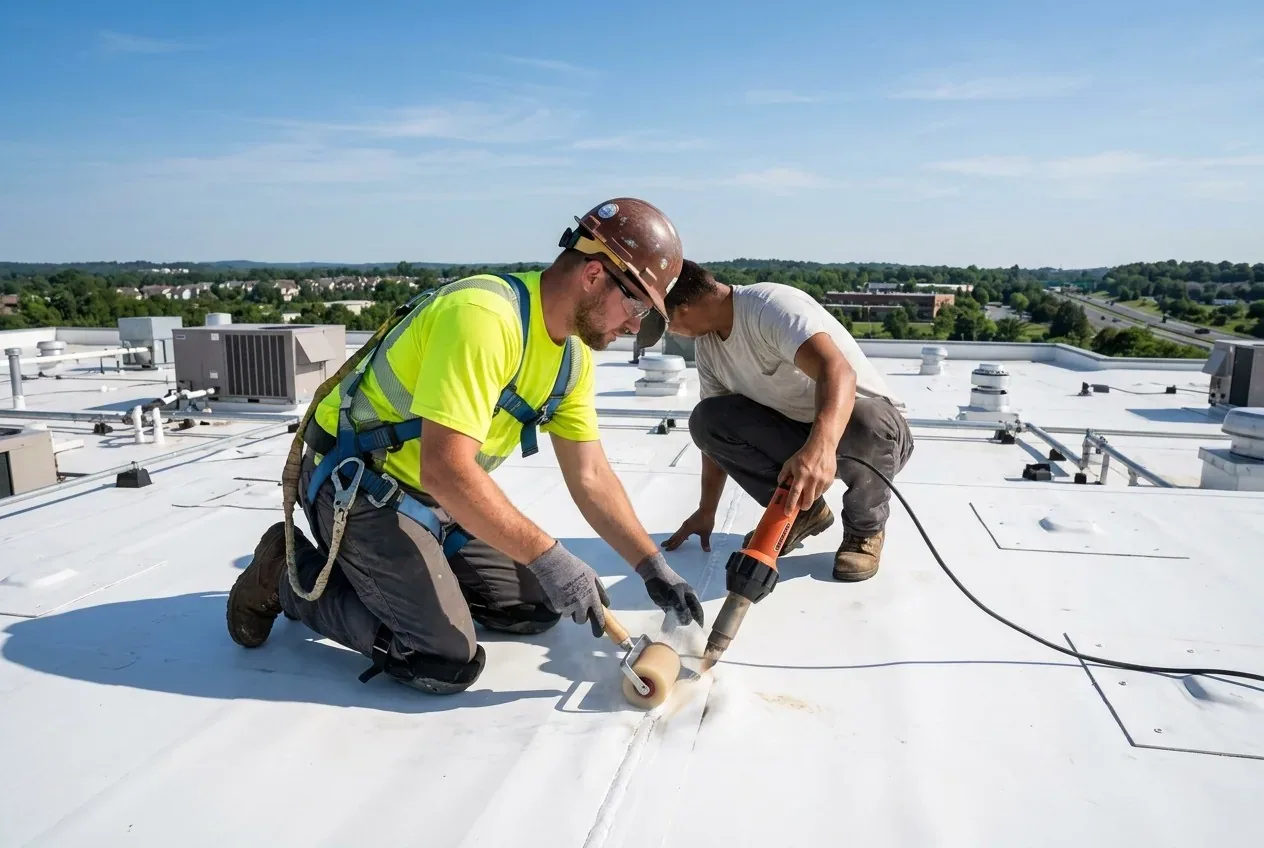
A failing equipment flashing deserves a repair allowance that includes its connection, supporting material and room for installation. Patching only the visible opening can leave the movement that caused it unresolved. Commercial Roofing Centennial evaluates planned commercial roof repairs in Centennial, CO, through the condition of each affected detail. We establish which components can be cleaned and repaired and which need removal before a durable connection is possible.
Highfield Business Park accommodates assembly, distribution, laboratory and office uses near E-470 and Peoria Street. That mix illustrates why a repair window should reflect actual activities beneath the roof as well as rooftop access. We discuss the affected area and the building's operating constraints during assessment. A limited repair can then receive a definite construction boundary without being confused with complete restoration or replacement.
A seam that opens repeatedly may have poor welding, contamination, inadequate bonding or movement elsewhere in the assembly. We inspect beyond the separated edge to find how the adjacent material is held and supported. Repair preparation can involve cleaning, trimming defective material or removing an older patch that prevents a sound connection. The chosen method depends on the membrane and the condition of the receiving surface.
Repeated seam separation can also indicate stress near an equipment curb or a poorly secured transition. A new strip across the opening may not address that stress. We assess securement and the adjoining detail before deciding how much material needs correction. Where failure extends into damaged insulation, the repair must include that supporting work. This creates a priced scope directed at the physical defect rather than a recurring allowance for the same surface patch.
A puncture repair requires enough clean, sound membrane around the damaged area to form a complete compatible connection. Brittle material, deeply worn surfaces and accumulated patch edges can limit that working area. We inspect the surrounding covering and choose a repair boundary that reaches suitable material. Where a cut has damaged insulation or opened a route into the assembly, the investigation also considers what happened underneath.
Different membranes require different preparation and joining methods. Repairs to PVC roofing use compatible materials and suitable heat-welded connections when the existing covering can receive them. Rubber membranes rely on their own compatible adhesives, primers and seam materials. Substituting a general sealant for the appropriate repair can leave an unreliable edge that separates with exposure. We explain material restrictions when they affect the available repair method and whether older patches must be removed first.
Wall transitions, pipes and equipment curbs create changes in plane where flashing must accommodate the surrounding construction. Loose terminations, unsupported corners and restricted movement can open those details before the field membrane shows broad deterioration. We examine the upper termination as well as the lower membrane connection. Water entering behind wall material can require correction above the roof surface rather than another bead along the bottom.
For penetration and skylight flashing repairs, we assess the available height, corner geometry and condition of the existing support. A properly formed repair needs working room around the full detail. Equipment stands and crowded utility lines can make partial access the main scheduling issue. We identify any required release before pricing construction. The owner can distinguish a flashing replacement from minor sealing and understand why a seemingly small detail sometimes requires a larger work area.
A damaged drain connection can admit water even while the surrounding membrane remains serviceable. We inspect clamping components, the membrane's connection and local water flow before deciding which parts need repair. Debris removal can restore an obstructed path, but it will not correct damaged components or a drain elevation that holds water nearby. Those conditions receive separate treatment according to what the examination reveals.
At Dove Valley Business Park, office, flex and industrial uses create a varied commercial setting for targeted maintenance work. Drain locations, overflow outlets and access for clearing debris establish which roof areas need examination during a repair visit. Repairs beside outlets must preserve that building's drainage and overflow paths. We also examine service routes where repeated foot traffic could damage nearby membrane. Suitable protection can reduce a recurring repair cause without requiring treatment of the whole roof surface.
Cleaning and drying the receiving surface can control a repair window more than the physical size of the patch. Residual moisture, low temperatures or unsuitable adhesive conditions may require different timing or temporary protection. We identify those limitations before selecting the installation day. A permanent repair needs its intended preparation and application conditions, even where the affected area seems modest.
Occupied operations may also limit the use of particular materials or require temporary adjustment of nearby air intakes. We discuss these needs where the repair method creates an actual dependency. An inspection of adjoining roof conditions can help identify related defects during the same access period. We keep those findings distinct from the authorized repair so the owner can approve additions deliberately. Combining suitable work can simplify access, but unrelated changes should not disappear into an undefined maintenance allowance.
A completed detail should have the intended connection, securement and water path before the work area is released. We examine seams, terminations and patch boundaries using methods appropriate to the materials involved. Photographs distinguish the original defect from the finished work, making later inspection more practical. The repaired area may still need attention to adjoining construction outside the roof scope, such as a deteriorated wall or equipment housing.
We separate immediate detail correction from broader deterioration that merits longer-term capital planning. A repair can provide useful service where surrounding construction is sound and accessible. Widespread embrittlement, saturated insulation or repeated failures across the roof may make continued patching a poor use of the maintenance budget. We explain those conditions without assigning an unsupported service-life promise. The owner receives a repair decision connected to the roof's present condition.
Movement or poor support beside the seam may require correction before new material is joined. We check securement, substrate condition and adjoining details. Replacing the visible strip alone can preserve the stress that repeatedly pulls the connection apart.
Usable membrane around the damaged area is the deciding condition. Older patches may need removal to expose a suitable receiving surface. Where the covering underneath is too deteriorated for compatible repair, we explain the larger boundary needed instead of adding another unsupported patch.
Investigation establishes which wet or damaged material can be measured before work starts. A repair allowance should explain how additional concealed damage will be assessed if an opening reveals it. We distinguish that possible supporting work from the known membrane or flashing correction.
Traffic protection can be added where the membrane condition and chosen materials support an appropriate installation. We examine how technicians reach service panels and drains, then identify suitable protected routes. The work should protect the assembly without obstructing runoff or hiding existing defects.
The completed work is checked against its specified connection and boundary, with photographs of the relevant details. A repaired seam, renewed flashing and rebuilt drain connection each require different examination. We explain any adjoining condition that still needs attention outside the agreed repair.
Commercial roofing in Centennial
Commercial roofing in Centennial
Commercial roofing in Centennial
Commercial roofing in Centennial
Commercial roofing in Centennial
Commercial roofing in Centennial