Examine ponding water on Centennial commercial roofs. We trace surface routes, outlet elevations and receiving layers before defining useful drainage repairs.
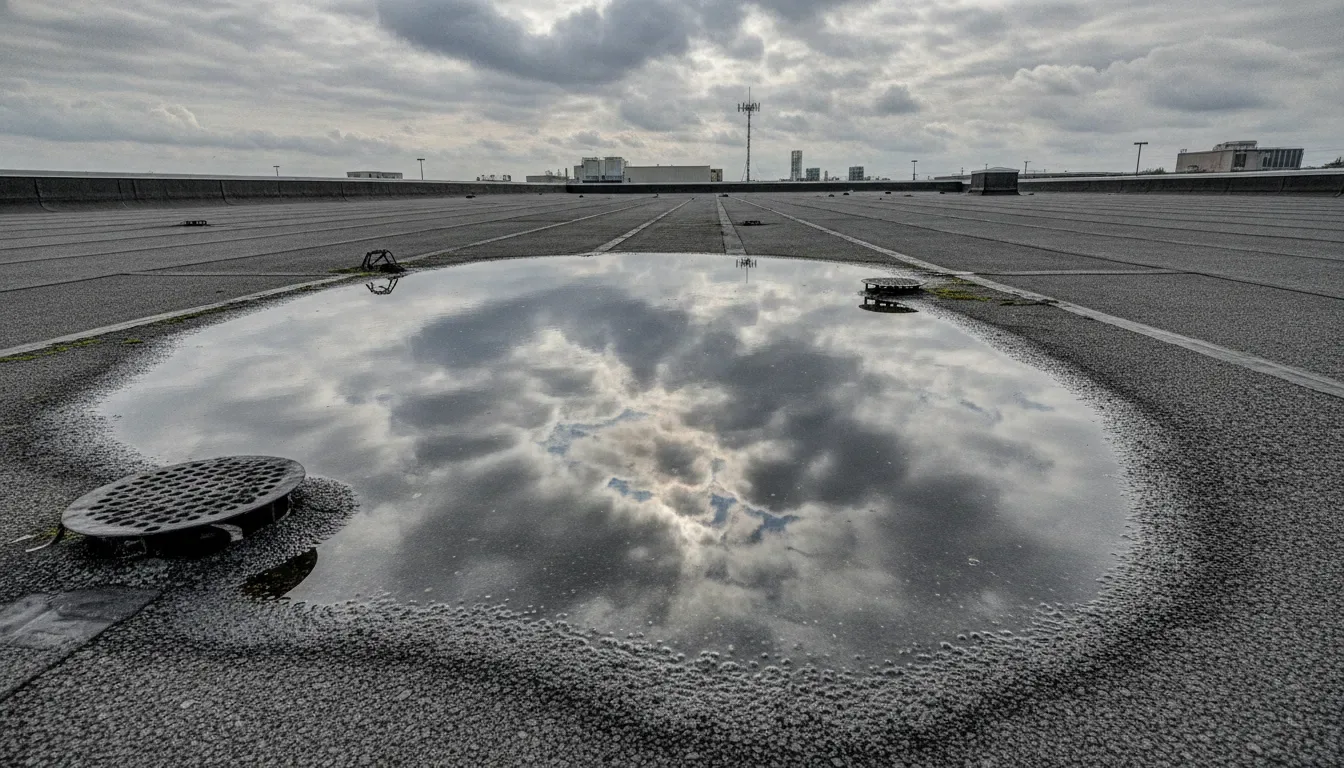
Paying for another covering treatment does not change a low receiving surface that keeps water behind a curb. The construction choice needs to identify the route water should take and the detail preventing it. Commercial Roofing Centennial assesses ponding water on commercial roofs in Centennial, CO. We examine surface geometry, outlets and concealed condition before defining the material work useful at the selected building.
Highfield Business Park includes assembly and distribution activity alongside technology, laboratory and office uses. Inverness Business Park combines office development with residential activity. Roofs serving properties in the wider commercial setting need their own drainage examination. We trace the actual water route and assess the construction around it, giving the owner a comparison between local outlet correction, surface adjustments and broader assembly work required by observed material condition.
A visible low area is one part of the drainage arrangement. We examine how nearby surfaces deliver water and where that water should leave the roof. Curbs, older repairs and layer changes can interrupt its approach. The useful correction should identify the physical restriction before a new field material is selected.
Roof outlet and discharge assessment includes the receiving elevation at a drain or scupper. A raised flange, surrounding buildup or blocked opening can require different work. We distinguish those conditions before defining the repair. The owner receives an identifiable outlet task and an explanation of the water route it restores, with adjoining surface work included where the connection cannot be corrected independently.
Debris can restrict an otherwise workable outlet, while an unobstructed opening can remain too high for a nearby low surface. We examine those relationships separately. Removing loose material may restore a route without rebuilding it. A depression or unsuitable receiving detail can require construction beyond a cleaning task.
Examination of roof drainage condition considers the surrounding covering and layers. Prior repairs can create a small ridge that changes water movement toward the outlet. We identify that feature and the receiving material before selecting removal or reshaping. At a scupper, the approach and opening should be considered with the discharge beyond the wall. A suitable inlet alone may leave another restriction downstream. We identify relevant adjoining work and its responsible party before selecting a roof correction that depends on that outlet carrying water through its complete intended route. The useful scope explains the cause of the retained water and the actual component needing correction, keeping a material repair separate from routine maintenance that would leave the same geometry unchanged.
Tapered insulation or a local cricket may provide a useful water route where the roof arrangement supports it. Its shape needs coordination with the outlet and adjoining interfaces. Raising one surface can reduce flashing clearance at a nearby curb. We assess those receiving elevations before fixing a proposed layer arrangement.
Insulation and receiving-board changes also need suitable support and attachment beneath the covering. A new slope should reach its intended outlet without leaving an abrupt unsupported transition. Board fit and detail preparation enter that construction scope. We describe the finished geometry alongside its receiving requirements, allowing the owner to compare a complete adjustment whose field, curb and drainage connections can be installed together.
Water held near a defect can enter underlying layers where the covering or its connection is open. We investigate relevant damage and concealed moisture before defining retention. Saturated insulation or deteriorated support can require removal beyond the surface detail. The new connection needs suitable material around and beneath its boundary.
Seam correction beside a ponding area identifies compatible preparation for the actual system. A rubber roof assembly uses different joining components from a thermoplastic covering. Prior treatments may need removal before either repair can reach a sound receiving surface. We explain those material tasks separately from reshaping the drainage route. A useful project should address both the weather connection and the geometry that affects the selected area.
Changes in supporting construction can contribute to a low area. Where findings raise a structural question, the relevant evaluation belongs before the roof layers are reshaped. A new surface should not conceal an unresolved receiving condition. We identify the observed geometry and supporting access necessary for the project parties to coordinate that work.
Equipment or service lines can also obstruct the route or the preparation needed beside it. Their responsible parties coordinate release or adjustment where required. A nearby curb flashing correction may need reconstruction as the drainage surface changes. We identify the receiving height and suitable connection for the finished layers, linking related equipment tasks with the roof detail they enable instead of leaving them unresolved beside a newly sloped field.
Midtown Centennial includes office development within a long-term planning area. At a selected occupied property there, an outlet correction may require interior access below the connection as well as work above it. We identify those spaces before removal. The owner coordinates protection and room availability through its actual operating arrangement.
For properties in Inverness Business Park, a roof serving office space needs material positions that fit its available access. We examine staging, roof entry and waste handling before scheduling the phase. The opening should remain within a boundary that can be appropriately completed or protected. Concealed findings requiring wider removal need revised protection and release before construction expands beyond the agreed area.
We examine the completed outlet connection and surrounding covering before the correction is released. The finished surface should follow the route described by the construction scope. The owner receives a clear boundary between renewed layers and material retained elsewhere. Related equipment or support tasks remain identifiable if another stage is still required.
Later servicing should leave the outlet approachable and remove material that could obstruct its opening. New equipment supports or repairs should preserve the corrected surface route. We explain those care considerations for the installed assembly. Subsequent examination can compare observed drainage and developing material condition before another expense is selected. Maintenance and future capital work then follow an identifiable roof arrangement, keeping the next correction tied to its actual receiving detail and the water path serving it.
The receiving geometry can remain unchanged beneath a new membrane. Drainage correction may need an outlet adjustment or changed surface construction. We identify that physical requirement before selecting the useful scope.
Its opening and surrounding elevations need examination together. Debris removal can restore a usable route, while unsuitable geometry may need material work. We explain which condition the proposed task addresses.
Raised layers can reduce available flashing height near the new high points. Those connections may require adjustment. We coordinate the finished surface with outlet and curb elevations before installation.
Wet insulation or damaged support may need removal around the correction. Retained material must suit the completed connection. We examine those layers before establishing the useful opening and its occupied protection.
The corrected water route and reachable outlet need practical care. Equipment supports and new details should not obstruct that arrangement. We explain those obligations with the installed construction at completion.
Commercial roofing in Centennial
Commercial roofing in Centennial
Commercial roofing in Centennial
Commercial roofing in Centennial
Commercial roofing in Centennial
Commercial roofing in Centennial
Commercial roofing in Centennial
Commercial roofing in Centennial