Plan roof edge, coping and gutter repairs in Centennial. We examine securement, joints and discharge routes to define complete perimeter work.
Replacing loose coping above a public entrance requires a work window for the perimeter as well as the metal itself. The repair must address its support, joints and connection with adjoining roof construction. Commercial Roofing Centennial assesses edge metal, coping, gutters and downspouts in Centennial, CO, before defining that work. We identify which components need renewal and which supporting conditions must be corrected first.
Lincoln Station District combines offices, retail and housing in a walkable transit setting, where exterior access can affect occupied activity. A building in that setting may need entrance protection and a suitable lifting location during perimeter work. We examine the actual roof edge and public route before pricing removal. The owner's decision can then include the construction and protection needed to complete the connection, rather than the replacement metal alone.
A loose edge component may have failed fastening, deteriorated backing or an unsuitable connection between the metal and its support. We inspect the attachment rather than assuming the visible panel is the only defective material. New metal requires construction capable of receiving its intended fastening and securement. Damaged wood, corrosion or poor existing support can change the removal boundary before a replacement component is installed.
The assembly also needs to suit the applicable design conditions and the particular edge configuration. A long perimeter run can include corners, changes in height and transitions requiring distinct details. We assess those locations before treating the job as one continuous strip. Damage associated with displaced edge components may extend into the membrane or adjacent flashing. The permanent scope should restore those connections as well as the outward-facing metal.
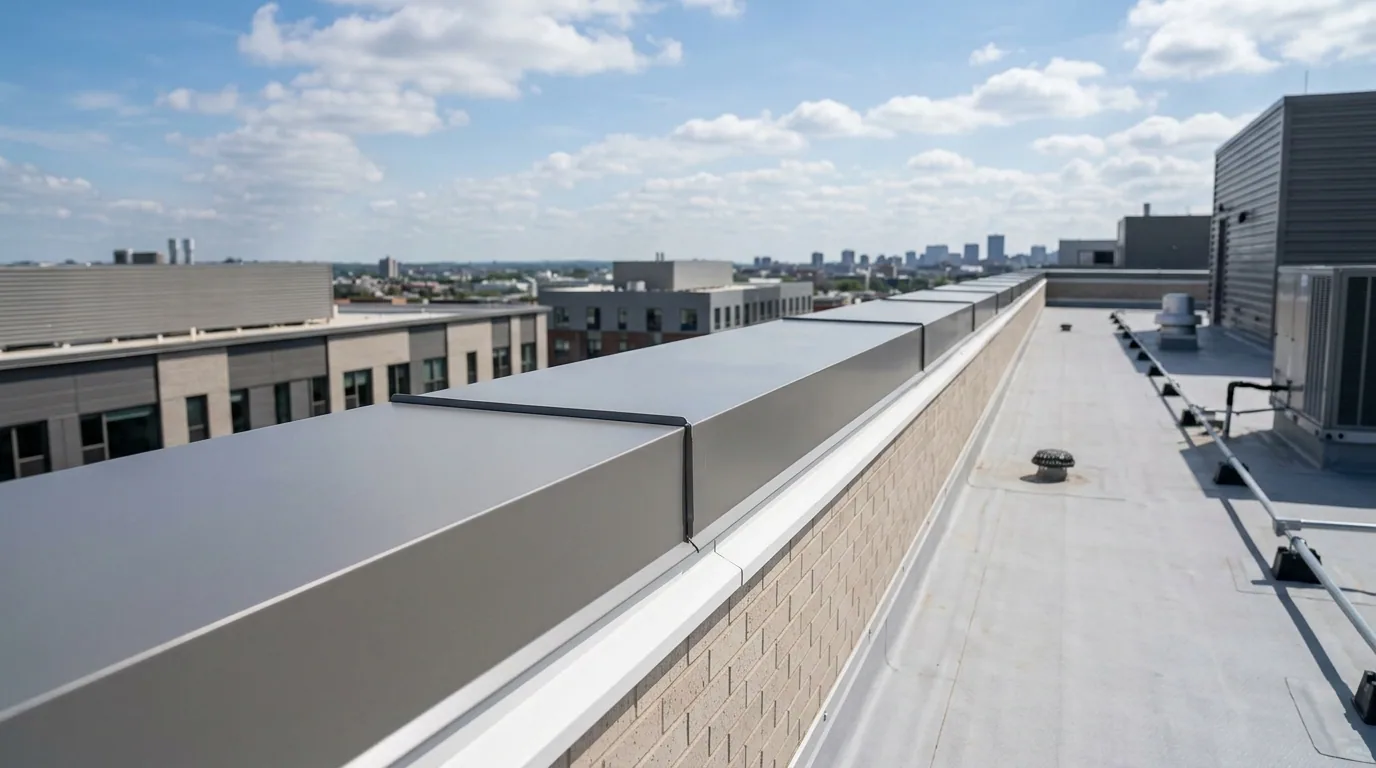
Coping protects the top of a parapet, where joints and ends need to accommodate movement while controlling water entry. Failed joints can allow water into the wall or behind adjoining roof flashing. We examine the cap, support and connection details to establish whether localized correction is suitable. Repeated joint failure may require a different joint arrangement or replacement of the affected run.
Metal expands and contracts with temperature changes, making movement provisions a practical part of the installation. We assess how each component is held and how adjacent pieces connect. Sealant at a joint has a supporting role within an appropriate detail, rather than serving as the sole answer to loose or improperly connected metal. The owner should understand which repairs renew a connection and which rebuild the construction that repeatedly opens it.
Drip edges, fascia transitions and perimeter flashing need complete connections with the roof covering behind or beneath them. Removing a metal component can expose those interfaces and reveal damaged material that was concealed. We examine how new metal will connect with the existing system before choosing the removal extent. The repair needs enough sound covering available to complete its intended membrane transition.
On standing-seam metal roofs, eave and rake details also interact with panel movement and closure components. Low-slope membrane assemblies have their own perimeter requirements. We establish the system involved instead of applying one connection method across both. Associated membrane repairs can be included where replacement metal reaches damaged covering. Separating the detail types within one proposal helps the owner assess how the completed edge will manage water and remain secured.
Gutter leaks can originate at joints, damaged sections or connections with downspouts, while overflow may involve blockage or unsuitable geometry. We distinguish those conditions before recommending replacement. The gutter's support and pitch need assessment where sagging holds water or changes how it reaches the outlet. Accumulated ice can also load damaged supports and distort a weakened section. We inspect those effects where present before deciding which connected components can remain in place. New sections must fit the adjoining components and discharge arrangement rather than end at a convenient visible boundary.
Scuppers and roof drainage outlets may discharge into conductor heads and downspouts that need coordinated examination. A restriction farther down the route can cause water to back up above it. We identify that relationship so gutter work does not omit a damaged outlet or downstream concern. Drainage changes affecting capacity require appropriate design consideration. The completed route should move water away as intended while leaving accessible components available for later cleaning and inspection.
Elizabeth's historic small-business downtown includes shopping, dining and seasonal open-air activity. Perimeter work beside those occupied uses needs a defined area for materials, falling-debris protection and any temporary restriction. We discuss the working height and access route during assessment, including whether a lift or another access method is appropriate. The protected area should match the actual removal work rather than an arbitrary closure around the building.
For commercial properties in Elizabeth, the repair sequence can separate one frontage from another where the roof details permit it. Entrances, delivery access and nearby public use may require coordination during each phase. An occupied-building work arrangement can also address perimeter construction during a larger roofing project. We explain the release needed at the affected edge so installation and building activity can proceed within a practical schedule.
Completed joints, corners and downspout connections need examination before the working area returns to ordinary use. We assess the installed securement and the water route relevant to the repaired components. Photographs identify what was replaced and any adjoining condition left outside the scope. That distinction is useful where the work addresses one roof frontage while other perimeter sections remain unchanged.
Subsequent perimeter maintenance should include debris clearing and observation of joints, supports and outlet connections. Loose material or renewed leakage deserves reassessment before it progresses into damage behind the assembly. We identify accessible items needing regular attention and any specialist work required at adjoining walls. The owner can then preserve the completed correction through focused care instead of budgeting repeatedly for the same unexamined perimeter symptom.
The receiving support must hold the intended securement. Deteriorated backing or damaged attachment can require correction before a new cap is fitted. We inspect that construction and explain the removal needed to reach suitable material, rather than replace only the visible piece.
Movement, poor support or unsuitable joint construction can defeat repeated sealing. We examine how adjacent components connect and where movement occurs. The repair may need a revised detail or replacement section instead of another surface application over the same failed connection.
Blockage, sagging or restricted discharge can cause overflow without establishing that the gutter size is the primary problem. We assess the entire relevant water route. Changes involving capacity or geometry need an appropriate basis before a larger component is selected.
The work boundary and access method guide which areas need restriction. Separate phases may be practical where the construction and protection arrangements allow them. We define the affected frontage with building personnel before materials are removed beside occupied public routes.
Securement, joints and the membrane interface all deserve review before the area is released. A sound-looking outer component can still leave a defective connection behind it. We assess the installed detail and record any adjoining work that remains outside the selected scope.
Commercial roofing in Centennial
Commercial roofing in Centennial
Commercial roofing in Centennial
Commercial roofing in Centennial
Commercial roofing in Centennial
Commercial roofing in Centennial
Commercial roofing in Centennial